
The United States is in the grip of a GLP-1 revolution. Over 44 million GLP-1 prescriptions were recorded across the United States in 2024, according to URBN Dental’s analysis of state-level usage data.
But as drugs like Ozempic and Wegovy move from specialist treatment to everyday use, a quieter health issue is emerging in parallel.
Our analysis of Google search trends and state-level prescription data reveals that March 2026 marks a historic tipping point: searches for both “GLP-1 side effects” and “dry mouth” have simultaneously hit their highest ever recorded levels.
For the first time, the scale of the problem is becoming visible – but for millions of patients already in the dentist’s chair with crumbling enamel and chronic bad breath, the warning may be coming too late.
Key findings:
- Searches for “GLP-1 side effects” have increased by 4,900% since January 2023, hitting an all-time high in March 2026
- Searches for “dry mouth” have simultaneously reached their highest ever recorded level in March 2026 – moving in lockstep with GLP-1 awareness
- Searches for “Ozempic side effects” have dropped 58% since their 2024 peak, as Americans shift to searching the broader drug category – a sign of growing medical literacy
- States with the highest GLP-1 usage show lower awareness of oral health risks – a nationwide awareness gap affecting tens of millions of patients
- California, Texas, Florida, and New York together generated over 92,000 searches for GLP-1-related oral health symptoms in 2024 alone
- States like New Jersey (+36%), Massachusetts (+48%), and Rhode Island (+68%) saw explosive prescription growth in 2024, with no equivalent rise in oral health awareness
- West Virginia is the most at-risk state in the country, with the highest GLP-1 usage rate (24%) and an awareness gap nearly five times worse than Hawaii, the best-performing state
- The ten most at-risk states are almost exclusively concentrated in the rural South and Midwest – including Kentucky, Oklahoma, Louisiana, Alabama, and Arkansas
- Despite lower prescription rates, large states including Texas, Georgia, New Jersey, and Ohio all sit in the riskier half of the awareness gap ranking
- California, Texas, Florida, and New York together generated over 92,000 searches for GLP-1-related oral health symptoms in 2024 alone
- States like New Jersey (+36%), Massachusetts (+48%), and Rhode Island (+68%) saw explosive prescription growth in 2024, with no equivalent rise in oral health awareness.
A Tipping Point in Public Awareness
The speed of this shift is extraordinary. In January 2023, Google searches for “GLP-1 side effects” registered a score of just 2 out of 100. By March 2026, that figure had reached 100 – the maximum possible score, representing the highest search volume ever recorded for that term. That is a 4,900% increase in public interest in under three and a half years.
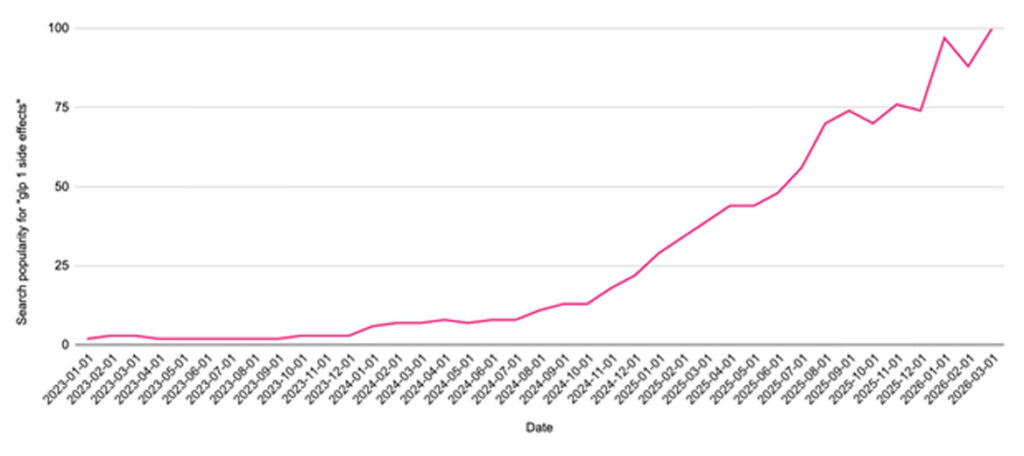
Dry mouth searches have followed the same trajectory, climbing consistently since mid-2023 and also hitting a peak score of 100 in March 2026 – the highest level ever recorded.
These are not two unrelated trends, they actually are the same story told twice.
Are GLP-1 Medications Causing Dental Problems?
Here is the data point that should alarm public health officials: searches for “Ozempic side effects” peaked in mid-2024 and have since dropped by 58%, falling from a score of 100 to just 42 by March 2026.
But this is not because interest in GLP-1 side effects is declining. It is because Americans are no longer asking about one specific drug, they are asking about an entire class of medication instead. Searches for “GLP-1 side effects” as a category have exploded by 4,900% over the same period. The public is becoming more medically literate, searching for clinical terms like “halitosis,” “xerostomia,” and “metallic taste in mouth” at volumes that would have been unimaginable three years ago.
What this means in practice: the oral health consequences of GLP-1 medications are no longer a niche concern. They are entering mainstream health consciousness right now.
The Awareness Gap: Ranking America’s Most At-Risk States
To identify where the problem is most acute, each state was assigned an Awareness Gap Index (0–100), combining GLP-1 usage rates (60%) and public awareness of oral health side effects (40%).
Higher scores indicate a greater gap between exposure and awareness, and therefore higher risk.
- 70–80 = very high risk
- 60–70 = high risk
- 40–60 = moderate
- below 40 = lower risk
West Virginia ranks as the most at-risk state in the U.S., with the highest Awareness Gap Index score. Nearly one in four residents is on a GLP-1 medication, the highest rate in the country, yet oral health symptom searches remain comparatively low on a per capita basis.
This may point to broader challenges around oral health awareness in the U.S., where preventative dental care and early symptom recognition remain inconsistent.
The five most at-risk states:
- West Virginia – Awareness Gap Index: 78.8 (24% GLP-1 usage and 77 searches per 100,000 residents)
- Kentucky – Awareness Gap Index: 76.7 (22% GLP-1 usage and 74 searches per 100,000 residents)
- Oklahoma – Awareness Gap Index: 76.4 (20% GLP-1 usage and 69 searches per 100,000 residents)
- Alaska – Awareness Gap Index: 73.3 (17% GLP-1 usage and 64 searches per 100,000 residents)
- Alabama – Awareness Gap Index: 69.6 (19% GLP-1 usage and 72 searches per 100,000 residents)
At the other end of the table, the five safest states benefit primarily from lower prescription rates rather than superior awareness – fewer people on the drugs means fewer people exposed to the risk.
The five least at-risk states:
- Massachusetts – Awareness Gap Index: 18.9 (11% GLP-1 usage and 92 searches per 100,000 residents)
- Rhode Island – Awareness Gap Index: 20.7 (7,5% GLP-1 usage and 82 searches per 100,000 residents)
- Nevada – Awareness Gap Index: 20.6 (8% GLP-1 usage and 83.4 searches per 100,000 residents)
- Virginia – Awareness Gap Index: 26,5 (12% GLP-1 usage and 90 searches per 100,000 residents)
- New York – Awareness Gap Index: 25.5 (14% GLP-1 usage and 89 searches per 100,000 residents)
The gap between top and bottom is stark: West Virginia’s awareness gap ratio is nearly five times worse than Hawaii’s.
The data also carries a warning for states that might assume they are insulated by size or healthcare infrastructure. Texas, Georgia, New Jersey, and Ohio all sit in the riskier half of the ranking. Pennsylvania, with over 2.2 million prescriptions filled in 2024, ranks 12th most at-risk nationally. This is not a rural footnote. It is a nationwide failure to connect the prescription pad to the dental chair.
Dry Mouth Sounds Harmless. For GLP-1 Patients, It’s Anything But
Dry mouth sounds minor, but it’s not.
Saliva is the mouth’s primary defence system. It neutralises acids, remineralises enamel, washes away bacteria, and prevents infection. When GLP-1 medications suppress saliva production, that entire defence system begins to fail. The result, left untreated, is accelerating tooth decay, advanced gum disease, persistent bad breath, and a significantly higher likelihood of needing costly restorative dental treatment.
The six most-searched oral health symptoms associated with GLP-1 use tell the story clearly:
- Dry mouth / xerostomia
- Halitosis and bad breath
- Metallic taste in mouth
- Tooth sensitivity
Every one of them is a direct downstream consequence of reduced saliva flow, and collectively they generated over 250,000 searches across the US in 2024.
California alone generated 32,700 searches for these symptoms. Texas produced 25,600. Florida 18,520. New York 17,980. These are not small numbers. They represent a patient population actively experiencing symptoms and looking for answers – answers that, in many cases, their GP or prescribing physician may not be equipped to give.
Why Dentists Need to Be Part of the GLP-1 Conversation
GLP-1 medications are not going away. Prescriptions grew by double digits in most states between 2023 and 2024 – New Jersey saw a 36% increase, Massachusetts 48%, Rhode Island an extraordinary 68%. The pipeline of new patients experiencing oral side effects will only grow.
What is urgently needed is a conversation that is not yet happening at scale: between patients and their dentists, and between the prescribing medical community and the dental profession. Right now, that means three things:
- Patients taking GLP-1 medications should proactively flag this to their dentist at every appointment
- Dentists should be asking every patient whether they are on weight-loss medication as a standard part of their clinical intake
- Prescribers should include oral health explicitly in the side effect briefing given to patients starting these drugs
The data shows that awareness is rising. But for the millions of patients in high-prescription states who are already suffering symptoms without understanding why, the tipping point may have arrived too late.
Methodology
URBN Dental analysed Google Trends data for “GLP-1 side effects”, “Ozempic side effects”, and “dry mouth” between January 2023 and March 2026, alongside state-level GLP-1 prescription volumes, usage rates, and oral health-related search demand across all 50 US states.
State search volumes for symptoms including dry mouth, halitosis, metallic taste, tooth sensitivity, and xerostomia were adjusted for population size and expressed as searches per 100,000 residents.
The Awareness Gap Index was created by combining GLP-1 usage rates (60%) with search awareness (40%). Scores were standardised on a 0–100 scale, with higher scores indicating greater medication exposure and lower relative awareness of oral health side effects.